
We are a professional review company that receives compensation from companies whose products we review. We test each product thoroughly and give high marks only to the ones that are the very best. We are independently owned, and the opinions expressed here are our own.
When I first came across the claim that cannabis is mentioned in the Bible, I was skeptical.
Very skeptical.
The argument centers on a mysterious ingredient in the holy anointing oil described in Exodus 30:23. In Hebrew, it is called qaneh bosem (קְנֵה־בֹשֶׂם), traditionally translated as “aromatic cane,” “sweet cane,” or “calamus.”
But there is an alternative theory.
According to this theory, qaneh bosem was actually cannabis.
At first, I thought this sounded like another attempt to read modern ideas back into an ancient text.
Then I started looking into the archaeology.
And things became considerably more interesting.
Because whether or not qaneh bosem meant cannabis, we now know something that would have been much harder to demonstrate only a few decades ago:
Cannabis really was used in a religious setting in ancient Judah.
That doesn’t prove cannabis is mentioned in Exodus.
It doesn’t prove cannabis was an ingredient in the holy anointing oil.
And it certainly doesn’t prove that someone deliberately removed cannabis from the Bible.
But it does mean the question deserves a more serious investigation than I initially thought.
So let’s look at the evidence.
Quick Answer
The Bible may mention cannabis, but we can’t currently prove that it does. The debate centers on qaneh bosem in Exodus 30:23, traditionally understood as an aromatic cane. Archaeologists have, however, found chemical evidence that cannabis was burned in a Judahite shrine at Tel Arad. That proves cannabis had a place in at least one ancient Judahite religious setting — but it does not prove that qaneh bosem was cannabis or that cannabis was an ingredient in the biblical holy anointing oil.
Part One: Did People in Ancient Judah Actually Use Cannabis?
For a long time, one obvious objection to the cannabis interpretation of Exodus was its geographical and historical aspects.
Was cannabis even available to the people who wrote and used these texts?
We now have a surprisingly clear answer.
At least some people in ancient Judah had access to it.
And we know this because of an archaeological discovery at Tel Arad.
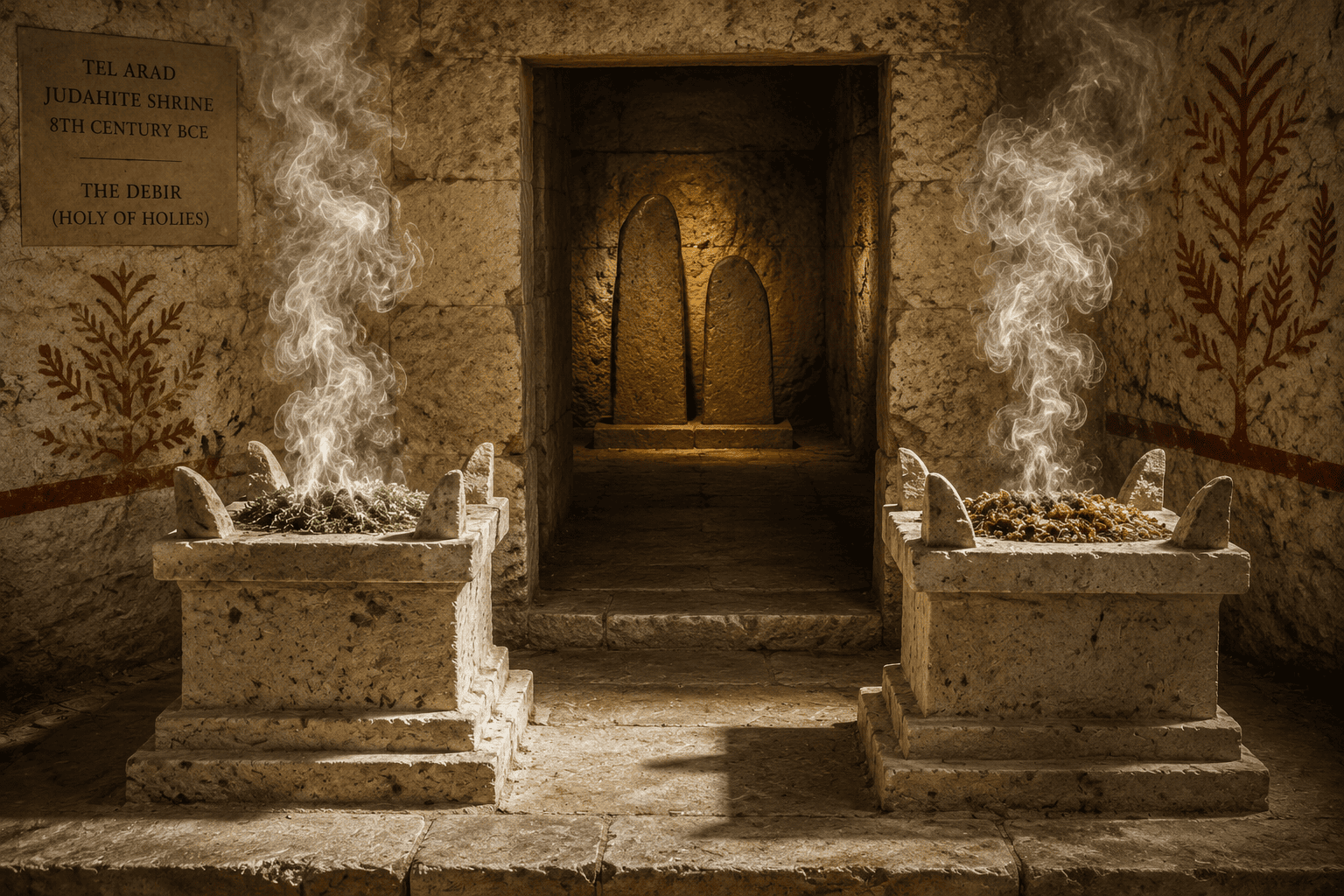
The Cannabis Altar at Tel Arad
Tel Arad is located in southern Israel.
Excavations there uncovered a small Judahite shrine containing two limestone altars.
The shrine dates to the Iron Age and was associated with the kingdom of Judah.
What made the discovery particularly interesting was that dark organic material had survived on the surfaces of the two altars.
Researchers Eran Arie, Baruch Rosen, and Dvory Namdar subjected samples from these remains to chemical analysis.
Their results were published in 2020 in Tel Aviv, the journal of Tel Aviv University’s Institute of Archaeology.
What they found on the smaller altar was remarkable.
The chemical analysis detected THC, CBD, and CBN, together with terpenes and terpenoids.
The researchers concluded that cannabis inflorescences had been burned on the altar.
This wasn’t simply evidence that hemp existed somewhere in the region.
It was cannabis on an altar inside a Judahite shrine.

Cannabis Mixed With Animal Dung
There was another curious discovery.
The cannabis residues were accompanied by residues attributed to animal dung.
That sounds rather less glamorous than holy incense, but there was probably a practical reason for it.
The researchers suggest that cannabis resin was mixed with dung to produce relatively mild heating.
The other altar tells us something important here.
On the larger altar, the researchers identified frankincense rather than cannabis.
But the frankincense had apparently been mixed with animal fat, which would help facilitate its evaporation.
In other words, the two substances appear to have been deliberately prepared differently.
Cannabis + dung.
Frankincense + animal fat.
That makes it difficult to explain the cannabis as accidental contamination.
Were Worshippers Getting High?
This leads to an obvious question.
Why burn cannabis in a shrine?
One possibility is its psychoactive effect.
Heating cannabis in this way could release psychoactive compounds into the air, potentially affecting people participating in the ritual.
That has led to some colorful descriptions of ancient Judahites effectively getting high while worshipping YHWH.
But we should be careful here.
Archaeology can tell us that cannabis was burned.
Chemical analysis can tell us quite a lot about how it was prepared.
It cannot interview the worshippers.
We don’t have a sign beside the altar saying:
“Burn cannabis here to enter an altered state before YHWH.”
The psychoactive interpretation is certainly plausible, especially given the substances identified and the method of heating.
But reconstructing the religious meaning attached to an ancient ritual is more difficult than identifying the chemicals involved.
One Shrine Is Still One Shrine
There is an equally important limitation to the Tel Arad discovery.
Finding cannabis at Tel Arad does not prove that cannabis was burned in every Judahite sanctuary.
It doesn’t prove that it was used at the Jerusalem Temple.
And it doesn’t prove that cannabis was commonly used throughout ancient Israelite religion.
This distinction matters.
It would be easy to create an argument like this:
Cannabis was found at Tel Arad → cannabis was widely used in Judah → cannabis was part of Israelite worship → therefore qaneh bosem was cannabis.
But every arrow in that argument requires additional evidence.
The archaeological discovery establishes something narrower and still extraordinary:
Cannabis was deliberately burned in at least one Judahite religious setting during the Iron Age.
That’s enough.
We don’t need to make the evidence say more than it does.
Cannabis Wasn’t Unknown in the Ancient World
Tel Arad also belongs within a much larger history of cannabis use.
One famous ancient account comes from the Greek historian Herodotus, who described the Scythians using hemp in what appears to have been a fumigation or steam-bath ritual.
Cannabis therefore wasn’t some modern substance that we have to imagine mysteriously appearing in antiquity.
People knew the plant and used it in different ways.
But evidence from another culture cannot establish what a particular Hebrew word meant.
It only tells us that cannabis use in the ancient world is historically plausible.
And Tel Arad takes us considerably further by placing cannabis inside a Judahite shrine.
Now we can ask the harder question.
Part Two: Does Qaneh Bosem Actually Mean Cannabis?
The controversial expression occurs in Exodus 30:23.
The passage gives instructions for producing a sacred anointing oil.
Among the ingredients are myrrh, cinnamon, cassia, olive oil, and:
קְנֵה־בֹשֶׂם — qaneh bosem
The latest Jewish Publication Society translation renders this as “aromatic cane.“
Other translations have traditionally used expressions such as “sweet cane,” “sweet calamus,” or “fragrant cane.”
So where does cannabis come from?
What Does Qaneh Mean?
The first word, qaneh, isn’t particularly mysterious. It is the ordinary Hebrew word for a cane or reed.
The second element, bosem, relates to fragrance, spice, or aromatic substances.
A very natural reading of the combination is therefore something along the lines of “aromatic cane“ or “fragrant reed.“
That immediately creates a problem for simplistic internet etymologies.
We don’t need cannabis to explain why the Hebrew Bible uses the word qaneh.
The second element, bosem, relates to fragrance, spice, or aromatic substances.
A very natural reading of the combination is therefore something along the lines of:
aromatic cane
or
fragrant reed.
That still doesn’t botanically identify the plant.
“Fragrant cane” describes it.
It doesn’t give us its Linnaean species name.
And that distinction is important.
What Did Ancient Jewish Translators Think It Meant?
This is where the claim of a later Christian mistranslation runs into a serious historical problem.
The Septuagint, the ancient Greek translation of the Hebrew Scriptures produced by Jewish translators centuries before Christianity, renders the expression kalamou euōdous — essentially “fragrant” or “sweet-smelling cane.”
That creates a serious chronological problem for claims that Christians later changed cannabis into calamus. The cane interpretation was already present in a Jewish translation tradition before Christianity existed.
And its translators did not leave us something that a Christian translator around AD 200 subsequently transformed.
They already understood the expression in terms of a fragrant cane/reed.
That means the traditional interpretation cannot simply have originated with a Christian mistranslation 1,700 or 1,800 years ago.
Whatever the correct botanical identification ultimately turns out to be, Jewish translators were already reading the expression in the cane/reed tradition before Christianity existed.
That’s a major piece of evidence.
Not necessarily against cannabis as the plant.
But strongly against a much later Christian origin for the traditional interpretation.
The Jewish Interpretation Didn’t Disappear Either
Later Jewish interpretation gives us another useful witness.
Rashi, the great medieval Jewish commentator, explains qaneh bosem essentially as a cane of sweet spices.
His explanation is fascinatingly simple.
Some canes aren’t aromatic, he says, which is why Scripture specifies the aromatic kind.
A rabbinic interpretation of Song of Songs similarly connects qaneh there with the qaneh bosem of Exodus and understands it as fragrant cane.
Again, none of this proves that those interpreters correctly identified the botanical species.
Ancient and medieval people could be wrong about plants.
But it makes a story in which Christians changed the meaning, and everyone subsequently forgot the original Jewish cannabis interpretation increasingly difficult to sustain.
Here’s Where Things Get Weird Again
Because Jewish literature does know hemp.
And the word used for it is interesting.
The Mishnah uses קנבוס — qanbos/kanbos in its agricultural discussions.
Later Jewish legal tradition explicitly identifies qanbos as hemp. Maimonides’ Mishneh Torah, for example, is translated using precisely that identification.
Bartenura’s commentary preserves additional forms for the plant, including kanapo and an Arabic equivalent.
Now compare:
qaneh bosem
qanbos
kannabis
Suddenly you can see why the alternative theory became attractive.
They look tantalizingly similar.
But this is also where we need to talk about one of the most dangerous traps in amateur etymology.
Words That Look Alike Aren’t Necessarily Related
Two words sounding similar can be evidence worth investigating.
It is not proof that they share an origin.
Hebrew belongs to the Semitic language family.
Greek and Latin belong to the Indo-European family.
Of course, speakers of these languages interacted for thousands of years.
Words traveled.
Plants traveled.
Trade goods traveled.
Empires brought languages into contact with one another.
So a word passing from one language family into another is entirely possible.
But a proposed loanword needs evidence.
We need to ask questions such as:
When is each form first attested?
What did it mean at that time?
Are the sound changes linguistically plausible?
Was there a plausible route of transmission?
Which language borrowed from which?
And perhaps most importantly:
Are we comparing the historical forms of the words, or just modern transliterations that happen to look similar on a screen?
Even Reading Ancient Hebrew Requires Some Caution
There’s another wrinkle.
Biblical Hebrew was originally written without the complete system of vowel points familiar from printed Hebrew Bibles today.
The Masoretes preserved an enormously valuable reading tradition centuries later through their system of vocalization and other signs.
That means we shouldn’t treat the modern transliteration qaneh bosem as though an Iron Age Israelite had written those Latin letters beneath the Hebrew.
The same caution applies to the distinction between sin and shin, represented today by dots placed over the Hebrew letter ש.
When I first looked at the Hebrew expression myself, I actually misread the sin in bosem as a shin and mentally pronounced something closer to boshem.
It’s an easy mistake to make visually.
More importantly, it illustrates why ancient etymology cannot simply be done by placing modern transliterations side by side and circling similar letters.
The Woman Who Proposed the Cannabis Connection
The modern interpretation of cannabis is particularly associated with the Polish anthropologist Sula Benet.
Her argument is often presented online as though she discovered that the Bible had been mistranslated.
The reality is much more interesting.
Benet proposed linguistic connections between the Hebrew expression and a family of ancient words associated with hemp or cannabis.
Her work was later published in the scholarly collection Cannabis and Culture, edited by Vera Rubin.
The proposed connections include forms associated with cannabis in other ancient languages.
And there is unquestionably something here worth investigating.
Ancient Greek really does have kannabis.
Later, Jewish Hebrew really does have qanbos referring to hemp.
Those aren’t inventions.
The difficult question is whether the biblical qaneh bosem belongs to the same etymological history.
That’s where the argument becomes much less certain.
The similarity is intriguing.
But intriguing isn’t the same as demonstrated.
What About Christian Interpretation?
Christian interpretation doesn’t reveal an obvious hidden cannabis tradition either.
Jerome’s Latin Vulgate continued the calamus tradition.
Martin Luther likewise translated the ingredient using Kalmus.
John Calvin’s Latin text similarly has calami aromatici (“aromatic calamus”). Characteristically, however, Calvin spends considerably more time discussing what the sacred anointing represents theologically than on identifying the precise botanical species involved.
However, I couldn’t find sufficiently reliable evidence that Origen, Augustine, or Zwingli offered a botanical identification of this particular ingredient that would materially change the argument.
The historical picture we can actually document is already enough.
The fragrant-cane interpretation is ancient.
It occurs in Jewish interpretation.
It occurs in Christian interpretation.
And crucially, it predates Christianity.
That makes the idea of a late Christian alteration extremely difficult to maintain.
But we still haven’t answered the botanical question.
So let’s put the strongest arguments on both sides of the scale.
Part Three: The Case For and Against Cannabis
There really is evidence on both sides.
But the evidence isn’t equally strong for every claim people make about it.
The Case for Cannabis
First, we can no longer dismiss the theory by saying ancient Judahites couldn’t possibly have known cannabis.
They did.
Tel Arad demonstrates that cannabis reached Judah and was used in a religious context. Chemical analysis identified cannabinoids on an altar in a Judahite shrine.
Second, cannabis is aromatic.
That makes it at least compatible with the description of an aromatic substance.
Third, cannabis was known elsewhere in the ancient world, so its presence in the region isn’t inherently anachronistic.
Fourth, the linguistic similarities noticed by Benet are real enough to deserve investigation.
We have ancient Greek kannabis.
We have later Jewish qanbos.
And we have biblical qaneh bosem.
It isn’t unreasonable to ask whether these forms could somehow be historically related.
That’s a legitimate question.
And finally, botanical identifications in ancient texts are notoriously difficult.
A traditional translation isn’t automatically correct simply because it became traditional.
All of that means I wouldn’t dismiss the cannabis interpretation as nonsense.
In fact, that’s one of the things that surprised me most while researching this article.
But there are substantial problems.
The Case Against Cannabis
The first problem is lexical.
Qaneh already has a perfectly normal Hebrew meaning involving cane or reed.
Bosem describes something aromatic.
We therefore don’t need an otherwise unknown compound word for cannabis to make sense of the Hebrew expression.
The second problem is historical.
The fragrant-cane interpretation is very old.
It isn’t something Christians suddenly invented centuries after Jesus.
That interpretation already appears in the Greek Jewish translation tradition before Christianity.
The third problem is Jewish reception.
Later Jewish commentators such as Rashi continued understanding the expression in terms of an aromatic cane rather than preserving an alternative cannabis identification.
The fourth problem may be the most interesting.
When later Jewish literature unmistakably discusses hemp, it has a word that looks much more directly like cannabis: qanbos.
That doesn’t necessarily disprove Benet.
But it means the historical linguistic relationship needs to be demonstrated rather than assumed.
And finally, Tel Arad doesn’t solve the lexical problem.
Finding cannabis in a Judahite shrine proves cannabis was there.
It doesn’t tell us that qaneh bosem means cannabis.
Those are two independent lines of evidence.
Conflating them would be making precisely the kind of mistake we’re trying to avoid.
What About the Holy Anointing Oil?
There’s another problem with some modern claims surrounding this passage.
Even suppose, for the sake of argument, that tomorrow archaeologists or linguists produced overwhelming evidence that qaneh bosem was cannabis.
What would that prove?
It would prove that cannabis was one ingredient in the holy anointing oil.
It wouldn’t automatically prove modern medical claims made about that oil.
Read Exodus 30 in context, and its purpose is explicitly sacred and cultic.
The mixture is called holy anointing oil. It is used to consecrate the tabernacle, its furnishings, Aaron, and his sons.
The text even places restrictions on its ordinary reproduction and use.
That’s a very different context from a modern dietary supplement or home remedy.
Botanical identification and medical efficacy are two completely separate questions.
What About the Exodus Effect?
This investigation originally began because I came across the Exodus Effect and its claims about the holy anointing oil in Exodus 30. As you’ve seen, some of the historical and archaeological evidence turned out to be considerably more interesting than I initially expected.
But whether cannabis may have been used in ancient Judah is a very different question from whether a modern product based on that idea actually works.
I investigated that separately, including the scientific research behind the ingredients and some of the claims made in the presentation.
Read my full Exodus Effect review to see what I found.
So, Does the Bible Mention Cannabis?
After looking into this, my answer is:
Possibly — but we don’t currently have enough evidence to say that it does.
And that’s considerably more interesting than the answer I expected when I began.
There is strong archaeological evidence that cannabis was used in at least one religious setting in ancient Judah.
That alone makes it impossible to dismiss cannabis and ancient Judahite religion as an obviously ridiculous combination.
The linguistic case is more complicated.
Sula Benet noticed genuinely interesting similarities between qaneh bosem and words associated with cannabis.
Later Jewish literature even uses qanbos for hemp.
But similarity isn’t enough to establish etymology, particularly when we’re dealing with multiple languages, thousands of years of linguistic development, trade, migration, and possible loanwords.
Meanwhile, the traditional interpretation of qaneh bosem as some aromatic cane has very ancient roots.
Most importantly, it existed in Jewish translation tradition before Christianity.
So the evidence leads us somewhere between two extremes.
“Cannabis was obviously never part of biblical-era Israelite religion“ is wrong.
Tel Arad has seen to that.
But:
“The Bible definitely prescribed cannabis in Exodus 30, and later Christians mistranslated it to hide the truth“ goes far beyond what the evidence can support.
The real history is messier.
Cannabis was present.
It was used religiously.
Ancient people knew the plant.
The Hebrew expression remains botanically disputed.
And an intriguing twentieth-century linguistic hypothesis has gradually become something much more certain in popular retellings than the underlying evidence warrants.
I started researching this because I thought the cannabis claim sounded like nonsense.
I don’t think that anymore.
But I also don’t think we’ve discovered a secret cannabis recipe hidden in the Bible for nearly two thousand years.
Instead, I found something better:
a genuine historical mystery where archaeology has made an old question considerably more interesting than it used to be.
And sometimes that’s a much more satisfying answer than either “yes” or “no.”
Found This Investigation Interesting?
If you know someone who has wondered whether cannabis really appears in the Bible, share this article with them.
Frequently Asked Questions
Does qaneh bosem in Exodus 30:23 mean cannabis?
It is possible, but it has not been proven. Qaneh bosem is traditionally understood as an aromatic or fragrant cane, while Sula Benet argued that the expression was linguistically connected with ancient words for cannabis.
The similarities are interesting, especially when compared with Greek kannabis and the later Jewish term qanbos for hemp. However, similar-sounding words are not enough by themselves to establish a shared etymology.
What does the Tel Arad cannabis discovery mean for qaneh bosem?
The discovery makes the cannabis hypothesis more historically plausible, but it does not prove the linguistic identification.
Researchers found chemical evidence of cannabis on an altar in a Judahite shrine at Tel Arad. This demonstrates that cannabis was available in ancient Judah and was used in at least one religious setting.
What archaeology cannot tell us is whether the biblical authors called that plant qaneh bosem. That requires linguistic evidence.
What is the “sweet-smelling cane” mentioned in Exodus 30:23?
The Hebrew expression is qaneh bosem (קְנֵה־בֹשֶׂם), which can be understood as an aromatic or fragrant cane. English Bible translations have rendered it in different ways, including “sweet cane,” “fragrant cane,” “aromatic cane,” and “calamus.”
Exactly which botanical species the biblical writer intended is less certain. Cannabis has been proposed as one possibility, but the identification remains disputed.
Was cannabis used in ancient Israelite or Judahite worship?
Yes, we now have archaeological evidence that cannabis was used in at least one ancient Judahite shrine.
Chemical analysis of residues from an altar at Tel Arad identified THC, CBD, and CBN. Researchers concluded that cannabis had been deliberately burned there.
However, Tel Arad is one site. The discovery does not prove that cannabis was routinely used throughout Judah, at the Jerusalem Temple, or in every form of Israelite worship.
Was cannabis deliberately removed or mistranslated in the Bible?
There is no good evidence that Christians deliberately removed cannabis from the Bible.
One major problem with that theory is chronology. The Septuagint — the ancient Jewish translation of the Hebrew Scriptures into Greek — already understood qaneh bosem in terms of a fragrant cane or reed centuries before Christianity emerged.
It is entirely possible for an ancient botanical identification to be mistaken. But that is very different from claiming that Christians deliberately changed the Bible to conceal cannabis. The surviving translation history does not support that conspiracy theory.
Rickard



What do you think about the article you've just read? Please tell me below.