
We are a professional review company that receives compensation from companies whose products we review. We test each product thoroughly and give high marks only to the ones that are the very best. We are independently owned, and the opinions expressed here are our own.
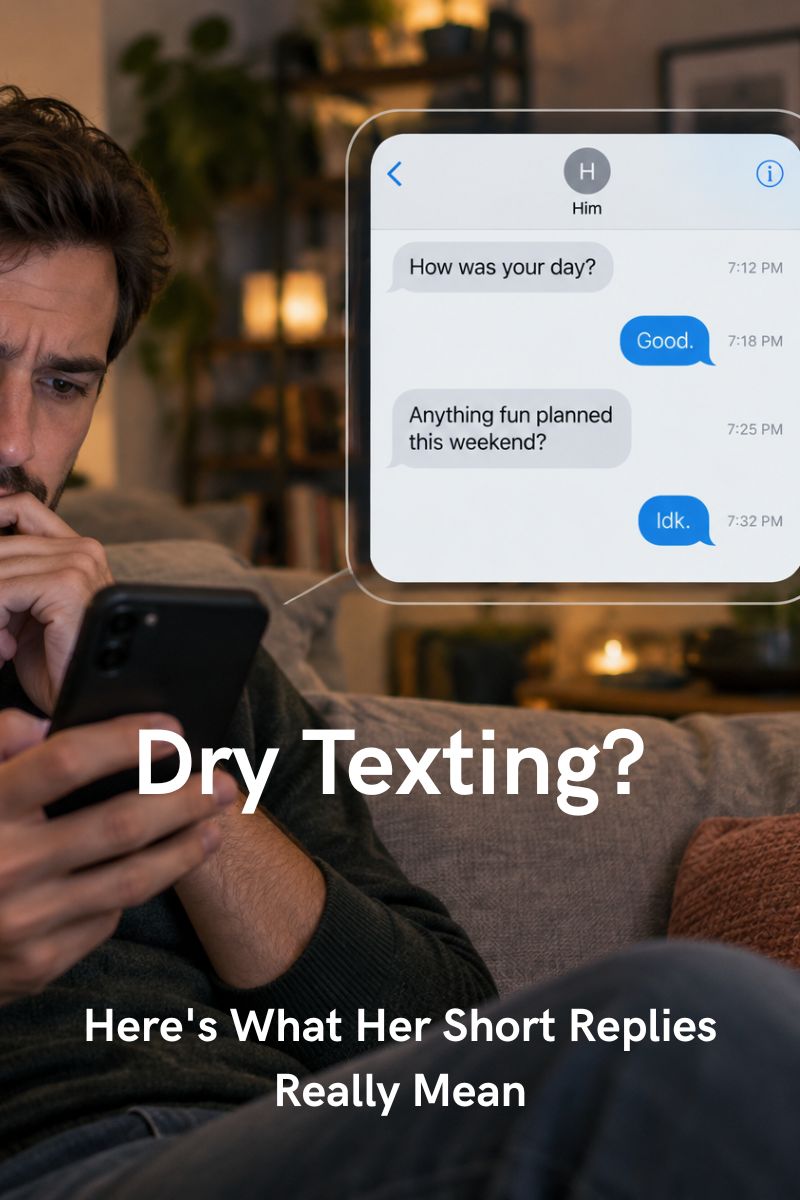
You send her a message.
She replies, “lol.”
You try another question.
“Yeah.”
You mention something interesting that happened during your day.
“Nice.”
And suddenly, you’re staring at your phone, wondering whether you’re having a conversation or conducting an interview with someone who would rather be somewhere else.
Sound familiar?
This is what people often call dry texting.
But here’s something important: A dry text doesn’t automatically mean she’s not interested in you.
Sometimes she’s busy. Sometimes texting isn’t her favorite way to communicate. And sometimes, yes, she’s responding politely without wanting anything more.
The challenge isn’t finding the perfect message to make her reply.
It’s understanding what’s happening and knowing what to do next.
In this guide, you’ll learn what dry texting means, how to recognize it, what to send back, and when it’s better to stop carrying the conversation.
What Is Dry Texting?
Dry texting means sending short, unenthusiastic, or low-effort messages that give the other person very little to respond to.
Common dry texting examples include:
- “K.”
- “Lol.”
- “Yeah.”
- “Cool.”
- “Nice.”
- “Idk.”
- “Maybe.”
- “Nothing much.”
But it’s not just about sending short messages.
Consider these two replies:
Reply A: “Yeah.”
Reply B: “Yeah! I went there last summer. Have you been?”
Both begin with the same word. But the second gives the conversation somewhere to go.
That’s the difference.
Dry texting isn’t necessarily about the number of words someone uses. It’s about how much they contribute to the exchange.
In November 2025, Cambridge Dictionary’s New Words blog featured dry texting as a term describing very brief messages that may suggest a lack of interest.
Notice that word: may.
A brief reply can be a sign of disinterest, but it isn’t proof.
And that distinction matters enormously when you’re dating.
7 Signs You’re Dealing With a Dry Texter
Before deciding what her messages mean, look at the bigger picture.
One short reply tells you very little. Repeated patterns tell you more.
1. She Mostly Sends One-Word Answers
You ask how her weekend went.
“Good.”
You ask whether she enjoyed the concert.
“Yeah.”
You mention something funny.
“Lol.”
Short answers aren’t inherently bad. But when every reply leaves you responsible for keeping things moving, the conversation can start to feel exhausting.
2. She Rarely Asks Anything About You
You know what she does for work, what music she likes, and where she went last weekend.
But she hasn’t asked much about your life.
This is worth paying attention to because interest isn’t just about answering questions. It’s also about showing curiosity.
That said, some people are naturally less inclined to ask questions over text. Look for whether she shows curiosity in other ways before drawing conclusions.
3. You Always Have to Introduce a New Topic
Every conversation seems to follow the same pattern:
You ask something.
She answers.
Silence.
You introduce another subject.
She answers again.
Eventually, you run out of ideas.
When this happens repeatedly, it may be a sign that the conversational effort is uneven.
4. Her Replies Have Suddenly Become Shorter
This is different from someone who has always preferred brief messages.
Perhaps she previously sent funny stories, asked questions, and seemed excited to talk.
Now you receive one-word responses.
Something may have changed.
But don’t assume the change must be about you. Stress, work, family circumstances, or simply having less time can also affect communication.
If you’re noticing this particular pattern, read my guide on why she’s texting you less.
5. She Doesn’t Build on Anything You Say
Imagine telling her:
“I finally tried that Italian restaurant you mentioned. The pasta was amazing.”
She replies:
“Nice.”
There’s nothing offensive about her answer.
But compare it with:
“Really? What did you order?”
The second response shows curiosity and creates another opportunity to connect.
6. You’re Doing Nearly All the Work
You’re starting the conversations, finding topics, asking questions, and suggesting plans.
She’s participating, but only when you initiate.
This doesn’t automatically mean she dislikes you.
However, it raises a fair question:
Would the connection continue if you stopped doing all the work?
We’ll explore that question later.
7. She Avoids Making Real Plans
A woman might send short texts because she prefers meeting face-to-face.
If she happily agrees to a date and follows through, her texting style may not matter very much.
But if she also avoids phone calls, never suggests another time, and repeatedly gives vague answers to invitations, that’s different.
The pattern matters more than any individual message.
Why Do People Dry Text? 5 Possible Reasons
One of the biggest mistakes people make is assuming that dry texting has only one explanation.
In reality, there are several possibilities.
1. She’s Busy or Distracted
Imagine answering messages while rushing between meetings, caring for children, or dealing with a stressful day.
You might send a quick “yeah” simply because you don’t have time for a longer answer.
That doesn’t mean you’ve suddenly stopped caring about the person who contacted you.
Instead of interpreting one brief response as rejection, consider the circumstances.
2. She Doesn’t Enjoy Texting
Some people love long conversations through messages.
Others use texting mainly to exchange information and arrange meetings.
Someone might be quiet over text but enthusiastic, funny, and attentive in person.
If she consistently shows genuine interest when you meet, her short messages may simply reflect her communication preferences.
3. The Conversation Has Become Repetitive
“How are you?”
“Good, you?”
“Good.”
“What are you doing?”
“Nothing much.”
“Cool.”
If this looks familiar, the problem might not be either person’s level of attraction.
It may simply be that neither person has introduced anything worth exploring.
The solution isn’t necessarily to send more messages.
It’s to make the conversation more meaningful.
4. She’s Unsure How She Feels
Not every dating situation begins with strong attraction.
Sometimes someone is curious but hasn’t decided whether they want to pursue anything romantic.
They may respond without investing much energy.
That uncertainty is normal.
However, it’s important not to confuse uncertainty with an invitation to keep pushing until the other person changes their mind.
5. She Isn’t Romantically Interested
Sometimes the simplest explanation is the correct one.
She may appreciate you as a person without wanting to date you.
She might respond because she doesn’t want to be rude.
She might even enjoy the occasional conversation without wanting the connection to become romantic.
This can be disappointing, especially when you really like her.
But there’s an important truth worth remembering:
Someone can enjoy your attention without wanting a romantic relationship with you.
And no clever text can guarantee that those feelings will change.
Dry Texting Examples: What to Send Instead
Let’s look at a few situations where changing your approach might make the conversation easier and more enjoyable.
These are examples, not magic messages. They work best when there is already some willingness to communicate.
| Situation | Dry exchange | A more natural approach |
|---|---|---|
| Asking about her weekend | “Good.” | “What was the highlight of your weekend?” |
| Talking about movies | “Yeah.” | “What did you think about the ending?” |
| Discussing hobbies | “Cool.” | “How did you get interested in that?” |
| Asking about plans | “Nothing.” | “Are you having a relaxing weekend or looking for something fun to do?” |
| Discussing a restaurant | “Nice.” | “Have you tried their pizza, or is there something better I should order?” |
Notice something about these examples.
You’re not trying to manipulate her.
You’re simply giving her an opportunity to share something more interesting.
And you’re allowing her to decide whether she wants to participate.
Example 1: When She Keeps Saying “Lol”
Let’s say you’ve been exchanging funny stories and she replies:
“Lol.”
You don’t necessarily need to rescue the conversation.
But if there’s a natural opening, you might say:
“That reminds me—what’s the funniest thing that’s happened to you this week?”
If she responds enthusiastically, great.
If the conversation stays flat, don’t feel obligated to keep producing jokes.
Example 2: When She Gives Short Answers About Her Weekend
Instead of repeating “What are you doing?” try connecting your message to something you already know about her.
For example:
“You mentioned you were trying a new hiking trail this weekend. How did it go?”
This demonstrates that you’ve paid attention.
It also gives her something specific to talk about.
Example 3: When She’s More Engaging in Person
If you’ve already met and enjoyed each other’s company, texting may not need to become your primary way of connecting.
You might say:
“I enjoyed talking with you last time. Want to grab coffee again this weekend?”
A clear invitation can tell you more than another week of guessing what “haha” means.
Example 4: When She Doesn’t Seem Interested
Suppose you’ve made several reasonable attempts to start conversations.
She rarely asks questions, never suggests meeting, and repeatedly gives vague responses.
In that situation, another carefully crafted message may not be useful.
You can simply stop initiating.
You don’t need to announce that you’re withdrawing attention or make her feel guilty.
Give the situation room to reveal itself.
How to Respond to Dry Texting Without Looking Desperate
The goal isn’t to become emotionally distant or pretend you care less than you do.
It’s to communicate naturally without taking responsibility for both sides of the conversation.
Here are five practical steps.
Step 1: Stop Treating Every Short Reply as a Problem
If she sends “okay,” don’t immediately assume something is wrong.
Maybe she simply meant okay.
A healthy conversation doesn’t require every message to be exciting.
Sometimes people are just confirming information.
Step 2: Make Your Messages More Specific
Instead of:
“How’s your day?”
Try:
“Did your presentation go well today?”
Instead of:
“What are you doing?”
Try:
“Have you decided which movie you’re watching this weekend?”
Specific messages can be easier to engage with because they give the other person a clear starting point.
But avoid turning every exchange into an interview.
Share your own thoughts and experiences too.
Step 3: Ask Better Follow-Up Questions
There’s actual research supporting the value of thoughtful questions.
In a 2017 study published in the Journal of Personality and Social Psychology, researchers found that people who asked more questions, particularly follow-up questions, tended to be better liked by their conversation partners.
The research also included face-to-face speed-dating conversations, where asking follow-up questions was associated with a greater likelihood of receiving agreement for a second date.
That doesn’t prove that a particular text will create attraction.
But it does support a useful principle: genuine curiosity helps conversations feel more engaging.
Read the research: It Doesn’t Hurt to Ask.
Step 4: Suggest Meeting When There’s Mutual Interest
One reason texting conversations become repetitive is that they continue long after the people involved have learned the basics about each other.
If you’ve been having pleasant, reciprocal conversations and you’re both comfortable, consider suggesting a simple date.
For example:
“I’ve enjoyed talking with you. Would you like to get coffee on Saturday?”
This is a straightforward invitation.
She can accept, decline, or suggest another time.
Whatever happens, you’ll have more useful information than you would from analyzing another ten one-word replies.
Step 5: Recognize When You’re Carrying the Conversation Alone
Here’s a question worth asking yourself:
“If I stopped sending messages for a few days, would there still be a connection?”
You shouldn’t use silence as a trick to provoke a reaction.
But neither should you feel that every relationship depends on your ability to keep another person entertained.
If the effort is consistently one-sided, it’s reasonable to step back.
The right person for you won’t necessarily be a fantastic texter.
But there should be some recognizable willingness to get to know you.
Are You Accidentally Dry Texting Her?
So far, we’ve focused mostly on receiving dry texts.
But what if you’re the one sending them?
This is worth considering before deciding that the entire problem lies with the other person.
Perhaps you’re nervous about saying the wrong thing.
Maybe you reply quickly without thinking.
Or perhaps you’ve become so focused on appearing relaxed that your messages no longer communicate much personality.
The solution doesn’t require becoming a comedian or writing paragraphs.
Try adding one of three things to your replies:
A detail: Something specific about your experience.
A reaction: A genuine response to what she shared.
A question: Something that shows curiosity.
For example:
Instead of “Good,” you could write:
“Pretty good. Finally finished that project I’ve been working on. How was your day?”
Instead of “Nice,” try:
“Nice! You mentioned you were looking forward to that. Was it as good as you’d hoped?”
You can still keep your messages short.
They just need to give the conversation somewhere to go.
What Research Says About Very Short Text Messages
A 2025 paper in the Journal of Experimental Psychology: General examined how texting abbreviations influence perceptions.
Across eight preregistered studies involving 5,306 participants, researchers found that abbreviations tended to make senders appear less sincere and recipients less inclined to respond.
One reason was that abbreviated messages could communicate a lower level of effort.
Importantly, this research studied abbreviations, not every type of short message or every romantic relationship.
So it doesn’t mean you must abandon casual texting.
It does suggest that small communication choices can affect how your messages are perceived.
Read the research on texting abbreviations.
Dry Texting vs. Lack of Interest: How to Tell the Difference
This is probably the most important part of the entire guide.
A woman who isn’t enthusiastic about texting can still be genuinely interested in dating you.
And a woman who responds politely may have no romantic interest at all.
So how can you tell the difference?
Look beyond the length of her messages.
| Sign | Possibly just her texting style | Possibly low romantic interest |
|---|---|---|
| Her messages | Short but consistent | Consistently closed and disengaged |
| In-person behavior | Warm, curious, attentive | Little engagement or enthusiasm |
| Making plans | Accepts or suggests alternatives | Repeatedly avoids making plans |
| Curiosity | Shows interest in other ways | Rarely shows curiosity |
| Communication | Makes some effort to connect | Leaves nearly all effort to you |
| Follow-through | Keeps agreements | Frequently cancels without rescheduling |
These aren’t guaranteed indicators.
A person can be shy, stressed, or uncertain for reasons that have nothing to do with attraction.
But together, these behaviors provide more context than a single “lol.”
Don’t Confuse Politeness With Romantic Interest
Imagine a man who really likes a woman.
He remembers her birthday, asks about her life, and always finds reasons to contact her.
She responds pleasantly.
He begins to believe that her friendliness means she’s developing romantic feelings.
But she never initiates contact, never accepts a date, and doesn’t indicate that she wants a relationship.
He may interpret every polite response as encouragement because he hopes the relationship will develop.
Psychologists sometimes describe this broader tendency as motivated reasoning: our desires can influence how we interpret information.
The important lesson isn’t that every friendly woman is secretly uninterested.
It’s that your hopes and her actions are two different things.
You can appreciate someone, communicate respectfully, and still recognize that the romantic interest isn’t mutual.
If you’re wondering whether you might be investing too much energy in a conversation, my article Am I Texting Her Too Much? explores that question in greater detail.
What Does Dry Texting Mean in a Relationship?
In a relationship, dry texting usually describes communication that feels unusually brief, emotionally flat, or disconnected.
But context matters.
If your partner has always preferred short messages, their texting style may simply be different from yours.
However, if your conversations used to be affectionate and engaging but suddenly become limited to “ok,” “fine,” and “whatever,” it’s reasonable to wonder whether something has changed.
Rather than assuming your partner is losing interest, try asking:
“I’ve noticed our conversations have felt a little different lately. Is everything okay?”
A healthy relationship doesn’t require constant texting, but it does benefit from mutual attention, honesty, and a willingness to communicate.
What Is the Dry Texting Method?
The phrase dry texting method can refer to deliberately sending short, low-effort messages instead of engaging in a normal conversation.
Some people may use this approach to appear less available, create emotional distance, or see whether the other person will make more effort.
But there’s a difference between naturally texting less and intentionally withholding attention to influence someone’s feelings.
If you’re busy, replying later is perfectly reasonable.
If you need space, communicate that honestly.
And if you’re deliberately sending cold messages to make someone chase you, consider whether that behavior supports the kind of relationship you actually want.
Better communication isn’t about making someone work harder for your attention. It’s about finding a level of effort that feels comfortable and mutual.
Dry Texting Memes and GIFs: Why They’re So Relatable
Dry texting memes often exaggerate the frustration of trying to have a conversation with someone who only replies with one word.
Imagine this exchange:
You: “I had the craziest day today. You’ll never guess what happened!”
Them: “Ok.”
You: “I got promoted at work!”
Them: “Cool.”
You: “Are you even interested in this conversation?”
Them: “Yeah.”
That’s the kind of awkward exchange dry texting memes make fun of.
People also use reaction GIFs to express the frustration of receiving another unenthusiastic reply.
A funny GIF might lighten the mood when both people enjoy playful conversations. But it won’t necessarily fix a lack of mutual interest.
And if you’re constantly relying on memes or GIFs to keep someone engaged, it might be worth asking whether the conversation is genuinely reciprocal.
Dry Texting Synonyms and Meaning in Spanish
There isn’t one perfect synonym for dry texting, but several expressions describe similar behaviors.
Common alternatives include:
- One-word replies: Responding with a single word.
- Low-effort texting: Sending messages that require little thought or engagement.
- Emotionally distant texting: Messages that feel cold or disconnected.
- Unenthusiastic replies: Responses that show little excitement.
- One-sided conversation: An exchange where one person carries most of the interaction.
These expressions overlap, but they aren’t always interchangeable.
For example, someone can send short messages while still contributing meaningfully to a conversation.
What Is Dry Texting in Spanish?
In Spanish, you might describe dry texting as responder de forma seca por mensaje (replying dryly through messages) or mandar mensajes secos (sending dry messages).
You might also hear respuestas cortantes, meaning curt or abrupt replies.
The exact wording varies by country and context.
Whatever language you use, the underlying idea is similar: messages that feel unusually brief, unenthusiastic, or difficult to build a conversation around.
When Should You Stop Texting a Dry Texter?
There’s no universal rule about how many short messages are too many.
But there are some useful questions to consider:
- Have you made reasonable attempts to start a natural conversation?
- Does she ever contribute something without being prompted?
- Has she shown any interest in meeting?
- Does she suggest alternatives when she’s unavailable?
- Do you feel that you’re always trying to earn her attention?
- Has she directly indicated that she doesn’t want a romantic relationship?
If she has clearly said she isn’t interested, respect that answer.
If she hasn’t given a clear answer but repeatedly avoids engaging or meeting, you don’t need to keep pursuing the conversation indefinitely.
You can step back without becoming resentful.
And if you’re already dating someone and their texting behavior suddenly changes, a direct conversation may be better than quietly guessing.
For example:
“I’ve noticed we haven’t been talking as much lately. Is everything okay between us?”
Then listen to the answer.
Healthy communication isn’t about finding hidden meanings in every message.
It’s about making room for honesty.
How to Keep a Text Conversation Going Naturally
If there’s already mutual interest, here’s a simple approach you can use.
Share Something, Ask Something, and Listen
Start by sharing a genuine thought or observation.
For example:
“I finally tried making homemade pizza yesterday. Let’s just say the kitchen looked like a flour explosion.”
Then invite her perspective:
“Are you someone who enjoys cooking, or do you prefer letting someone else handle dinner?”
If she responds with a story, build on it.
If she asks you something, answer naturally.
And if she’s busy, allow the conversation to end without treating that as a failure.
Good conversations have a rhythm.
They don’t need to continue every minute of the day.
For more help understanding why otherwise promising conversations sometimes fade, read Why Conversations Die So Quickly on Dating Apps.
If you want a more structured approach to improving your texting skills, you can also read my Magnetic Messaging Review to see what the program teaches, who it may help, and whether it’s worth considering.
From Better Texting to a Real Date
Texting can be a wonderful way to begin getting to know someone.
But it shouldn’t become an endless examination of every word, emoji, or response time.
If she’s showing genuine interest, you don’t need the perfect message.
You need a natural opportunity to move the connection forward.
That might mean suggesting a phone call, sharing an experience, or asking her on a date.
And if she isn’t interested?
Respecting that is just as important as knowing how to start a conversation.
The goal of better texting isn’t to convince someone to like you. It’s to make it easier for two interested people to connect.
Want to Turn Your Text Conversations Into Real Dates?
If she’s already showing interest but you’re unsure how to move the conversation forward, you don’t have to keep guessing what to say next.
I’ve put together my 10 best texts to help you ask her out and move from texting to a real date.
These messages aren’t magic tricks, and they can’t create attraction where none exists. But they can help you communicate your intentions naturally and confidently.
Get My 10 Best Texts to Get Her on a Date – Free
Frequently Asked Questions About Dry Texting
What does dry texting mean in dating?
Dry texting describes messages that feel short, flat, or difficult to respond to. Examples include repeated one-word replies, minimal engagement, and conversations where one person does nearly all the work. It doesn’t automatically mean someone has lost romantic interest.
Is dry texting a red flag?
Not necessarily. Some people naturally prefer short messages or communicate better in person. However, repeated low effort combined with avoiding plans and showing little curiosity may indicate a lack of mutual interest.
How do you respond to a dry text?
Try one specific, natural message that connects to something the person has already shared. If the conversation remains one-sided, avoid repeatedly trying to force engagement. When appropriate, suggest a phone call or date instead.
Does dry texting mean she’s losing interest?
It can, but it isn’t proof. Look for changes in her behavior, whether she shows curiosity, and whether she’s willing to make plans. A consistent pattern is more informative than one short reply.
Can someone be interested in you but dry over text?
Absolutely. Someone can be brief in messages and still be warm, attentive, and enthusiastic in person. Their willingness to spend time with you and follow through on plans may tell you more than their texting style.
How do I stop being a dry texter?
Add a relevant detail, genuine reaction, or thoughtful follow-up question to your messages. Show curiosity and share something about yourself instead of relying exclusively on short acknowledgments.
Should I ask a dry texter out?
If there are other indications of mutual interest and you both feel comfortable, a simple invitation can be appropriate. If the person repeatedly avoids making plans or has expressed disinterest, respect that rather than continuing to ask.
Is dry texting the same as ghosting?
No. With dry texting, the person still replies, although the messages may feel unenthusiastic. Ghosting generally involves stopping communication without explanation.
Final Thoughts: Don’t Chase a Conversation That Isn’t Happening
Dry texting can be frustrating, especially when you’re excited about getting to know someone.
But you don’t need to become a mind reader.
You don’t need to spend hours crafting the perfect response.
And you certainly don’t need to convince someone to want a relationship with you.
Start by making your own communication thoughtful and natural.
Look for genuine curiosity and mutual effort.
Suggest meeting when the interest is there.
And recognize when it’s time to step back.
Because the best conversations aren’t necessarily the longest or the most entertaining.
They’re the ones where both people actually want to participate.
Dating Coach Rickard Österholm


What do you think about the article you’ve just read? Please tell me below.