

We are a professional review company that receives compensation from companies whose products we review. We test each product thoroughly and give high marks only to the ones that are the very best. We are independently owned, and the opinions expressed here are our own.
The date seemed to go well.
She laughed. She asked questions. The conversation flowed. Maybe she stayed longer than you expected. Maybe she even kissed you before you went home.
Then, a day or two later, you hear something confusing:
“I had a great time, but I didn’t feel the chemistry.”
Wait.
If she enjoyed the date, wasn’t she interested?
And if she kissed you, wasn’t she attracted to you?
So what exactly was missing?
This is one of the more confusing parts of dating because people often use words like interest, attraction, chemistry, spark, and connection as though they all describe the same thing.
They don’t necessarily.
A woman can enjoy spending time with you without wanting a relationship.
She can find you physically attractive without feeling that something deeper is developing.
And two people can experience strong chemistry while being completely wrong for each other in the long run.
Understanding these differences can help explain one of the most frustrating dating experiences:
Everything seemed to be going well – and yet the connection still didn’t develop.
What Does Interest Mean in Dating?
Interest is probably the broadest of the three.
If a woman is interested in you, she wants to know more about you.
She may ask questions, enjoy talking to you, respond enthusiastically to your messages, accept another date, or seem curious about you.
That’s good.
But interest doesn’t automatically mean romantic attraction.
Think about how many people you’ve enjoyed talking to without wanting to date them.
You can find someone funny, intelligent, interesting, or fascinating without imagining kissing them.
Dating interest can also be exploratory.
She may genuinely not know how she feels about you yet.
That’s part of what dates are for.
She’s spending time with you because she’s interested enough to discover whether something more develops.
And you’re doing the same thing with her.
Interest opens the door. It doesn’t tell you what will happen after you walk through it.
What Does Attraction Mean?
Attraction adds another dimension.
Instead of simply thinking:
“I enjoy talking to him.”
There is some degree of:
“I’m drawn to him.”
That can include physical attraction, but attraction isn’t determined entirely by physical appearance.
How you speak, move, smell, flirt, listen, carry yourself, respond to her, and make her feel when you’re together can all influence attraction.
And importantly, attraction can change.
Someone can look fantastic in a dating profile but become less attractive once you meet them.
Someone else might not immediately be your usual “type,” but become increasingly attractive as you get to know them.
That’s one reason reducing attraction to a checklist of physical features misses so much of what happens between two people.
But attraction alone doesn’t guarantee dating will progress.
A woman can find you attractive and still decide that she doesn’t want another date.
Which brings us to the word that causes perhaps the most confusion.
What Does Chemistry Mean in Dating?
Chemistry is harder to define because people don’t always mean the same thing when they use the word.
Some people mean sexual tension.
Others mean emotional connection.
Some describe chemistry as effortless conversation, playful flirting, feeling unusually comfortable together, or simply experiencing a difficult-to-explain “spark.”
That’s why hearing:
“There wasn’t enough chemistry.”
can be frustrating.
What exactly does that mean?
A practical way of thinking about chemistry is that it describes what seems to happen between two people when they interact.
Attraction can exist primarily in your experience of another person.
Chemistry involves the dynamic created between you.
Maybe conversation becomes playful without either person forcing it.
Eye contact lingers slightly longer.
You naturally move closer.
Silence doesn’t feel uncomfortable.
You make each other laugh.
You’re curious about what might happen next.
But chemistry is not a mathematical formula.
Two people can experience the same date differently.
And that’s where things get complicated.
Can She Be Interested in You Without Being Attracted to You?
Absolutely.
She might genuinely enjoy your company.
She may think you’re funny, intelligent, kind, or interesting.
She might happily spend two hours talking to you.
But she may still not feel romantic interest.
This is one reason a date seeming to go well isn’t always enough to predict whether there will be another one.
From your perspective, you might think:
“We talked for three hours. She was laughing. We had so much in common. That was a great date.”
She might agree with every word of that description.
And still think:
“I liked him, but I didn’t feel attracted to him.”
Neither person necessarily misunderstood what happened.
You experienced different parts of the interaction differently.
Can She Be Attracted to You but Feel No Chemistry?
Yes.
Imagine seeing someone across a room and immediately finding her attractive.
Attraction already exists before you’ve exchanged a single word.
Then you start talking.
And… nothing happens.
Conversation feels forced.
Your humor doesn’t connect.
Your personalities clash.
Neither of you seems particularly curious about the other.
The physical attraction may still be there, but the interaction itself doesn’t create much excitement.
Dating apps make this especially easy to experience.
A profile can create attraction.
Meeting determines what happens when two actual human beings enter the same room.
That’s why:
“I find you attractive”
and
“I feel chemistry with you”
aren’t necessarily identical statements.
Can You Have Chemistry Without Being Compatible?
This distinction may be even more important.
Because chemistry can feel incredible.
You can’t stop talking.
The flirting is effortless.
You want to touch each other.
You think about her when you’re apart.
Everything feels intense.
And yet your lives may be completely incompatible.
You want children. She doesn’t.
You want commitment. She wants something casual.
Your values conflict.
Your lifestyles don’t fit.
Neither of you handles conflict particularly well.
Chemistry tells you something about how the connection feels.
Compatibility tells you something about whether two lives can actually work together.
Ideally, a healthy long-term relationship contains both.
But chemistry alone can’t guarantee one.
Why Would She Kiss You If She Didn’t Feel Chemistry?
This question can be especially confusing.
If she kissed you, surely that proves she was attracted to you?
It can indicate attraction.
But people aren’t laboratory instruments that produce perfectly consistent signals.
She may have wanted to see how the kiss felt.
She may have been attracted to you in that moment.
She may have enjoyed the date but realized afterward that she didn’t want to continue.
Or she may have interpreted the experience differently than you did.
A kiss is information.
It isn’t a contract for another date.
This is why trying to decode one individual moment can drive you crazy.
What happens afterward often tells you much more.
Can Attraction and Chemistry Grow Over Time?
Sometimes.
Not every strong relationship begins with fireworks.
People can become more attractive as you discover their personality, confidence, humor, warmth, intelligence, or character.
Chemistry can also develop as two people become more comfortable around each other.
But that doesn’t mean attraction can always be manufactured just by trying hard enough.
If someone tells you she doesn’t feel the connection she’s looking for, arguing with her perception rarely creates it.
You don’t need to prove that the date objectively went well.
You don’t need to present evidence.
And you don’t need to convince her to feel differently.
Attraction isn’t a debate you can win.
Why Can a Date Feel Great to You but Not to Her?
I’ve experienced this myself.
I’ve been on dates where, from my perspective, everything seemed to be working.
The conversation felt good. Nothing obviously went wrong. I came away thinking the date had gone well.
She experienced it differently.
That can be hard to understand because we naturally evaluate an interaction through our own experience.
If I felt comfortable, perhaps she did too.
If I felt chemistry, surely she noticed it.
If I thought the conversation flowed, how could she think something was missing?
But two people can have the same date while experiencing it differently.
You have access to your thoughts, emotions, expectations, and attraction.
You don’t have direct access to hers.
That’s why a date can genuinely feel successful to you while leaving her uncertain.
It doesn’t necessarily mean you missed some enormous mistake.
Sometimes two people don’t experience the connection in the same way.
Chemistry Isn’t Mind-Reading
Another problem occasionally shows up in dating.
Some people expect a potential partner to intuit what they want without clear communication.
A look is supposed to tell you what to do.
A subtle change in tone is supposed to reveal what she’s feeling.
You’re expected to “just know.”
And when you’ve only recently started dating someone, that’s an unrealistic standard.
You haven’t spent years learning each other’s expressions, habits, moods, and communication patterns.
You barely know each other.
Being attentive is useful.
Learning to read body language is useful.
Paying attention when someone seems uncomfortable is important.
But chemistry isn’t telepathy.
A healthy connection should gradually make communication easier, not require you to pass a secret test where you’re expected to interpret every glance correctly.
If someone wants something from you, communication eventually matters.
You can become better at noticing signals.
You cannot become responsible for reading another person’s mind.
Why Do Women Sometimes Lose Interest After Dates That Seemed to Go Well?
Because a good date and growing romantic attraction aren’t necessarily the same thing.
Maybe she enjoyed herself but didn’t feel enough attraction.
Maybe there was attraction but little chemistry.
Maybe both existed, but she noticed an incompatibility.
Maybe she met someone else.
Maybe something changed in her life.
Or maybe her interest didn’t develop further.
That’s why I’ve written separately about why women lose interest after a few dates.
The important thing is not to conclude automatically:
“I must have ruined everything.”
Sometimes there is something useful to learn from what happened.
Other times, the connection didn’t progress.
Dating involves discovering both possibilities.
Stop Trying to Decode One Signal
This is where many men make dating much harder than it needs to be.
They focus intensely on individual signals.
“She used a heart emoji.”
“She touched my arm.”
“She kissed me.”
“She replied in five minutes.”
“She said she had fun.”
Any of those things can be encouraging.
None of them tells you everything.
Instead, watch the pattern.
Does she continue talking to you?
Does she initiate sometimes?
Does she seem engaged when you communicate?
Does she accept another date?
Does she help make that date happen?
Does her investment increase as you get to know each other?
Those patterns are usually more informative than trying to interpret one glance, text, kiss, or emoji.
And if she suddenly stops responding altogether, that’s a different problem from trying to interpret one isolated signal.
I’ve broken down some of the most common reasons in Why Did She Stop Texting Me?
The reverse can happen too. A woman may keep talking to you without actually moving the connection toward a date. If that’s happening, here’s why she may keep texting but not want to meet up.
What If Her Behavior Starts Changing?
This is where the distinction becomes particularly useful.
Suppose she initially seemed interested.
She replied quickly.
She asked questions.
She agreed to dates.
She sometimes initiated conversations herself.
Then something changes.
Her messages become shorter.
She takes longer to reply.
She stops initiating.
Making plans becomes difficult.
Now you’re no longer trying to answer an abstract question about chemistry.
You’re observing a behavior change.
That doesn’t automatically tell you why it changed.
But it gives you something concrete to focus on.
If you’re experiencing that now, understanding why she’s texting you less can help you see the pattern without panicking over every message.
And if you respond to her pulling away by dramatically increasing how often you contact her, you can create another problem.
At that point, it may be worth asking:
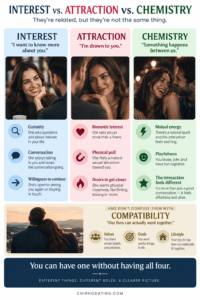
Interest vs. Attraction vs. Chemistry: The Difference
The easiest way to remember the difference is this:
Interest:
“I want to know more about you.”
Attraction:
“I’m drawn to you romantically or physically.”
Chemistry:
“Something happens between us when we’re together.”
And I’d add a fourth:
Compatibility:
“Our lives, values, needs, and relationship goals can actually work together.”
You don’t need to classify every interaction into one of these categories obsessively.
Dating isn’t an exam.
The point is to understand why:
“But the date went well!”
doesn’t always mean:
“Therefore she must want another one.”
And why:
“She was attracted to me.”
doesn’t necessarily mean:
“Therefore we’re right for each other.”
Final Thoughts: Pay Attention to What Develops
You cannot control whether another person feels attraction or chemistry with you.
And you shouldn’t have to perform perfectly to keep the right person interested.
What you can do is become better at noticing what develops between you.
Is curiosity growing?
Is attraction becoming mutual?
Does communication become easier?
Are both of you investing?
Do you actually enjoy who you become around each other?
Those questions tell you much more than trying to decipher one mysterious glance across a restaurant table.
The goal isn’t to become perfect at reading women.
It’s to become better at recognizing reciprocity.
Because when something healthy is developing, you shouldn’t be the only person trying to make it happen.
Rickard



What do you think about the article you've just read? Please tell me below.