
We are a professional review company that receives compensation from companies whose products we review. We test each product thoroughly and give high marks only to the ones that are the very best. We are independently owned, and the opinions expressed here are our own.
Please note: This article contains only links to relevant government agencies and internal resources on this website. All links are displayed in bold red text throughout the article. AI was used to help correct the grammar and generate the images.
Long before Facebook existed, long before dating apps, and long before someone could steal a soldier’s photographs or generate a convincing face with artificial intelligence, there was the letter.
The technology was different.
The story was different.
But the basic idea might sound surprisingly familiar.
Someone far away had access to something valuable.
There was a problem preventing them from reaching it.
They needed help from someone they could trust.
And if you provided a relatively small amount of money now, something much greater would be waiting for you later.
Today, many people associate this kind of fraud with the infamous “Nigerian prince” email and the scams known as Nigerian 419.
But Nigeria didn’t invent the underlying scam.
Not even close.
Versions of the same psychological mechanism existed hundreds of years before email — and some early forms even promised romance.
Understanding that history is useful because it reveals something important about modern Nigerian romance scams:
Countries change. Technology changes. Stories change. The underlying pattern can remain remarkably similar.
Before the Nigerian Prince, There Was the Spanish Prisoner

One of the best-known historical ancestors of modern advance-fee fraud was the Spanish Prisoner scam.
Different versions of the story circulated, but the basic premise was simple.
A wealthy or important person was supposedly being held prisoner in Spain.
They had access to a considerable fortune but couldn’t reach it while imprisoned.
Someone needed to provide money first.
Perhaps the money would pay a ransom.
Perhaps officials needed to be bribed.
Perhaps there were travel or administrative expenses.
Help solve the problem, and you would be generously rewarded when the prisoner was released.
But there was always another problem.
Another expense.
Another payment.
The fortune remained tantalizingly close but permanently out of reach.
If that sounds familiar, it should.
Replace the prisoner with an online lover.
Replace the hidden fortune with the promise of finally being together.
Replace the ransom with a plane ticket, customs fees, a medical bill, a military leave fee, or a frozen bank account.
The story has changed.
The mechanism hasn’t changed nearly as much.
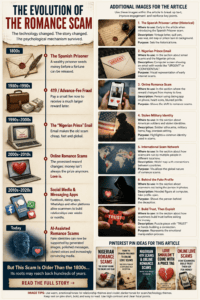
These are only some of the common stories used in romance scams.
The Scam May Be Even Older Than the Spanish Prisoner
Even calling the Spanish Prisoner the beginning doesn’t tell the whole story.
Forms of advance-fee fraud have much older roots, with versions of prisoner-and-hidden-treasure stories dating back centuries.
Some accounts trace variations of the prisoner scheme back to the 16th century.
And here’s where the history becomes particularly interesting for an article about romance scams.
In some versions, helping the imprisoned wealthy man didn’t merely promise financial reward.
The victim might also be promised the hand of the prisoner’s beautiful daughter.
Think about that for a moment.
Hundreds of years before Tinder, Facebook, WhatsApp, or email, a fraudulent story could already combine:
money + distance + urgency + trust + the promise of romance.
Social media has also changed how these relationships begin. Our guide to Facebook romance scams shows how something as ordinary as a friend request can develop into a much longer confidence scheme.
The delivery system was a letter rather than a dating profile.
Human psychology was still human psychology.
The Postal System Made Scams Easier to Scale
A scammer can only deceive the people they can reach.
Technology changes that equation.
As postal systems expanded and international communication became easier, fraudsters could send variations of the same story to people they had never met.
The recipient didn’t need to know the prisoner personally.
The letter supplied the story.
Why were you receiving it?
Because you had supposedly been selected as a trustworthy person who could help with a sensitive situation.
That detail survives remarkably well in modern scams.
You aren’t just another person.
You’re special.
You’re trustworthy.
You’re the only person they can ask.
You understand them when nobody else does.
That feeling of being uniquely chosen can be financially dangerous.
Why Was It Called the Spanish Prisoner?
Spain became part of the story because the scam needed distance, mystery, and circumstances that were difficult for the recipient to verify.
Versions of the fraud continued through the 19th century and into the early 20th century.
Real political turmoil and war could make the stories sound more plausible.
Someone really could be imprisoned.
Families really could be separated.
Fortunes really could become inaccessible.
Travel and communication really were difficult.
The scammer didn’t need to invent a completely impossible world.
They only needed to place a fictional person inside a believable one.
That principle remains important today.
A good romance scam story doesn’t necessarily sound ridiculous.
It often contains enough truth to make the lie believable.
Then the Story Moved to Nigeria
By the late 20th century, another version of advance-fee fraud had become internationally notorious.
The stories varied.
A government official needed help transferring money.
A businessman had died and left millions behind.
Someone had access to an abandoned bank account.
A wealthy family needed to move money out of the country.
Political instability had trapped a fortune.
The recipient could receive a substantial percentage of the funds in recognition of their help.
There was just one problem.
A fee had to be paid first.
Then another.
And another.
These schemes became strongly associated with Nigeria and eventually came to be widely known as 419 scams.
What Does “419” Mean?
The number refers to a section of Nigeria’s criminal law associated with fraud.
Over time, “419” became shorthand for advance-fee scams, particularly scams associated with Nigeria.
The basic proposition was wonderfully simple:
Give me a relatively small amount of money now, and you’ll receive a much larger amount later.
Of course, the promised fortune never arrives.
Instead, new obstacles appear.
Legal fees.
Taxes.
Transfer fees.
Bribes.
Certificates.
Banking problems.
Administrative costs.
Every payment supposedly moves the victim one step closer to the reward.
And every payment creates another reason not to walk away.
Then Email Changed Everything

The internet didn’t invent advance-fee fraud.
It solved one of its biggest logistical problems.
Distribution.
Sending thousands of physical letters costs money and takes time.
Sending thousands — eventually millions — of emails is dramatically easier.
That helped create one of the most famous internet scams of all time:
the Nigerian prince email.
You probably know the stereotype.
A prince, government official, wealthy widow, businessman, or other supposedly important person has millions of dollars trapped somewhere.
They need your assistance transferring it.
Help them, and you’ll receive a percentage.
To people who grew up hearing jokes about Nigerian princes, the scam can sound absurd.
But mass scams don’t need everyone to respond.
They only need the right person to respond.
And the internet made finding that person much easier.
From “Nigerian Prince” to “Yahoo Boys”
As internet access expanded, advance-fee scams evolved with it.
Understanding how scammers operate helps explain why the person establishing the relationship may not be the only person involved.
In Nigeria, the term “Yahoo Boys” became associated with some young people engaged in various forms of internet fraud.
But the stereotype of a single person sitting alone in an internet café, sending poorly written emails, increasingly fails to capture how modern fraud works.
Scams can involve multiple people.
Different individuals may handle different parts of the operation.
One person may establish contact.
Another may communicate with victims.
Someone else may handle money.
Stolen identities may come from completely different countries.
Money may pass through intermediaries or money mules.
And the person whose photograph you’re looking at may have absolutely nothing to do with the scam.
The internet allowed the operation to become both more global and more personal.
And that brings us to romance.
The Reward Changed From Money to Love

The classic advance-fee scam promised wealth.
Romance fraud discovered another powerful reward:
a future with someone you love.
That changes the emotional equation dramatically.
Imagine receiving this message from a stranger:
“Please send me $2,000 because my bank account is frozen.”
You probably wouldn’t.
Now imagine the same request coming from someone who has messaged you every morning for four months.
Someone who knows about your children.
Someone who listened when you talked about your divorce.
Someone who says they love you.
Someone you’ve discussed marrying.
Someone you believe you’re finally going to meet.
The financial request hasn’t become more logical.
But emotionally, it can feel completely different.
The scammer isn’t necessarily promising:
“Send money, and you’ll become rich.”
The promise can become:
“Help me solve this problem, and we can finally be together.”
That’s one reason modern romance scams can still use remarkably similar scripts even when the profiles and technology look completely different.
What Does a Nigerian Romance Scam Look Like Today?
There isn’t one Nigerian romance scam script.
That’s important.
The scammer doesn’t necessarily claim to be Nigerian.
In fact, they may claim to be almost anyone.
An American soldier. One familiar variation uses a stolen military identity, which we cover separately in our guide to military romance scams.
A British engineer.
A doctor.
An offshore worker.
A successful businessman.
A widower raising a child alone.
A contractor working overseas.
Someone living in your own country but temporarily unable to meet.
Using someone else’s identity to create a relationship can also involve catfishing.
The identity needs to accomplish two things:
Create trust and explain the distance.
Once the relationship develops, a financial obstacle may appear.
Perhaps they need money for:
- Travel
- Medical treatment
- A family emergency
- A frozen bank account
- Customs fees
- A business problem
- Phone or internet access
- Military-related expenses
- A visa
- A package
- Cryptocurrency or another investment
The details can change enormously.
Look underneath them and the older structure begins to appear again:
There is something valuable on the other side of an obstacle, and your money can supposedly remove the obstacle.
The “American Soldier” May Never Have Spoken to You
This deserves special attention.
Suppose you’re talking to an American service member stationed overseas.
You’ve seen dozens of photographs.
You search their name.
The soldier exists.
Does that prove the relationship is genuine?
No.
The photographs may have been stolen from a real service member.
The name may be real.
The career may be real.
The photographs may show actual military service.
The only false part may be the person talking to you.
This is one reason identifying romance scams by nationality is so unreliable.
The scammer’s claimed identity may tell you almost nothing about where the person controlling the account actually lives.
Why Nigeria Became the Symbol of Online Scams
By the early internet era, Nigerian advance-fee fraud had become so famous that the country itself became part of internet culture.
“Nigerian prince” became a punchline.
People who had never encountered an actual 419 scam knew the joke.
That cultural association didn’t come from nowhere.
Nigeria has had a real history of organized advance-fee and internet fraud, and Nigerian fraud networks have been involved in romance scams.
Pretending otherwise wouldn’t help anyone.
But there’s an equally important second half to that statement:
Romance fraud is not a Nigerian phenomenon.
Scammers operate internationally.
Victims live internationally.
Money can cross several countries.
Accounts can be managed from one place, while payments are received elsewhere.
Photographs can be stolen from someone living thousands of miles away.
A scammer can claim any nationality they think makes the story convincing.
Nigeria became one of the most recognizable symbols of internet fraud.
It did not become its exclusive home.
Does Someone Being Nigerian Mean They’re a Scammer?
No.
And nationality is a terrible scam-detection system.
Millions of Nigerians use Facebook, dating apps, Instagram, WhatsApp, and other online platforms for the same reasons as everyone else.
They make friends.
They date.
They fall in love.
They build businesses.
They talk to people abroad.
Being Nigerian is not a warning sign that someone is a romance scammer.
Likewise, someone claiming to be American, British, Swedish, Canadian, Australian, or anything else doesn’t make them safe.
If your strategy for avoiding romance scams is:
“Don’t date Nigerians online,”
you’ve learned the wrong lesson.
A scammer can tell you they’re from somewhere else.
A much better rule is:
Don’t identify the scam by nationality. Identify the pattern.
What Patterns Should You Look For?
Forget the passport for a moment.
Look at the behavior.
The Relationship Moves Extremely Fast
You’re suddenly the most important person in someone’s life despite never having met.
Their Identity Is Difficult to Verify
Every reasonable method of independent verification encounters another obstacle.
Distance Explains Everything
Work, military service, travel, family responsibilities, or another situation permanently prevents meeting.
Emergencies Keep Appearing
One unusual event may be bad luck.
An endless sequence of perfectly timed crises deserves more scrutiny.
Money Eventually Enters the Relationship
The relationship begins emotionally but gradually develops a financial component.
You Become the Only Solution
There are apparently no relatives, employers, banks, friends, colleagues, government agencies, insurers, or other resources available.
Only you can help.
The Reward Is Always Just Beyond the Next Payment
One more fee.
One more ticket.
One more transfer.
One more problem.
Then you’ll finally be together.
That last pattern should sound familiar by now.
It is remarkably close to the old advance-fee structure.
Why Bad Grammar Isn’t the Warning Sign It Used to Be
For years, people were told to look for strange spelling and grammar in scam messages.
Sometimes that still helps.
But technology has changed.
Translation tools are better.
Artificial intelligence can rewrite messages.
AI can help maintain a more convincing conversational style.
It can help scammers create photographs, voices, and other materials to support a false identity.
A modern scammer doesn’t necessarily need to write like the stereotypical Nigerian prince email.
The disappearance of obvious grammatical mistakes doesn’t mean the disappearance of fraud.
It means verification matters more than ever.
AI Brings the Story Full Circle
Think about how far the delivery system has traveled.
A handwritten letter.
A postal network.
Fax machines.
Mass email.
Dating websites.
Facebook.
Instagram.
WhatsApp.
Cryptocurrency.
Artificial intelligence.
Every technological shift creates new opportunities to tell an old story more convincingly.
AI may improve the fake identity
But it doesn’t necessarily change the underlying psychological mechanism.
There is still trust.
There is still something desirable.
There is still an obstacle.
There is still urgency.
And eventually, there may still be a request for money.
The Most Dangerous Scam May Not Look Nigerian at All
The cultural stereotype can actually create a false sense of security.
If you expect a Nigerian scammer to:
- Say they’re Nigerian
- Use poor English
- Send an obvious copy-and-paste message
- Mention a prince
- Ask for money immediately
- Use an obviously fake photograph
then a sophisticated scammer only needs to avoid those characteristics.
They may claim to be from your own country.
Their English may be excellent.
Their messages may be personal.
Their photographs may look unique.
They may spend months talking to you.
They may never mention Nigeria.
That’s why the history of Nigerian scams is useful.
The lesson isn’t:
“This is what Nigerians do.”
The lesson is:
“This is how an old fraud mechanism keeps adapting to new technology.”
What If You’ve Already Sent Money?
Don’t send more money simply because you’ve already invested so much.
That’s one of the oldest traps in advance-fee fraud.
The next payment is always presented as the payment that finally solves everything.
Stop.
Save the conversations.
Save email addresses, usernames, photographs, phone numbers, receipts, bank information, cryptocurrency addresses, and documents.
Contact the financial institution or payment provider involved as quickly as possible.
Tell someone you trust.
And be especially careful if another person later contacts you claiming they can recover your money for a fee.
The promise of recovering your loss can become another version of the same mechanism:
Pay something now to receive something much larger later.
If Someone You Love May Be Involved in a Romance Scam
Don’t begin by mocking the story.
Remember how these scams work.
The victim may have spent months building what feels like a genuine relationship.
They may have shared personal experiences.
They may have imagined a future together.
They may genuinely love the person they believe they’re talking to.
From the outside, you see contradictions.
From the inside, they may see someone they trust going through a terrible emergency.
Help them investigate specific claims instead.
Ask:
“Can we verify this independently?”
Rather than:
“How could you possibly believe this?”
Stopping the next payment matters more than winning the argument.
From the Spanish Prisoner to AI: The Story Keeps Changing
Hundreds of years ago, a letter could tell you about a wealthy prisoner who needed your help.
Later, someone needed assistance moving a fortune.
Then came the Nigerian prince.
Then email scams became dating scams.
The fortune became a relationship.
The stranger became someone you loved.
Today, the photographs may be stolen or generated.
AI may assist the messages.
The money might be sent via cryptocurrency rather than through a bank.
But underneath all those technological changes sits an extraordinarily durable idea:
Something you deeply want is waiting for you.
There is only one problem standing in the way.
And somehow, despite all the other people and institutions in the world…
you are the person who needs to pay to solve it.
That’s the pattern worth remembering.
Not a nationality.
Not an accent.
Not bad grammar.
Not whether someone looks Nigerian, American, British, or anything else.
The technology changes. The story changes. The scammer changes.
The pattern is what gives them away.
Frequently Asked Questions About Nigerian Romance Scams
Are All Romance Scammers From Nigeria?
No.
Romance scams are an international form of fraud, and scammers can operate from many different countries. Nigeria has a documented history of advance-fee fraud, and some modern romance scam networks have operated from Nigeria, which helps explain why the country became so strongly associated with online scams.
But nationality is not a reliable indicator of whether someone is a scammer.
A scammer operating from one country may claim to be an American soldier, a British engineer, a doctor, a contractor, a business owner, or someone living close to you.
Instead of trying to identify a scammer by nationality, look at their behavior, whether their identity can be independently verified, and whether money eventually becomes part of the relationship.
Why Are Romance Scams Associated With Nigeria?
The association developed partly from the international prominence of Nigerian advance-fee or 419 fraud.
These scams existed before the internet, but email made it possible to contact enormous numbers of potential victims cheaply. Stories involving Nigerian officials, businessmen, inheritances, and supposedly trapped fortunes became so widespread that the “Nigerian prince” eventually became part of popular internet culture.
Some Nigerian fraud networks later became involved in online dating and romance scams as communication moved to dating websites, social media, and messaging apps.
However, the underlying advance-fee scam is much older than its association with Nigeria.
What Does 419 Mean in Nigerian Scams?
“419” refers to a section of Nigerian criminal law associated with fraud.
The term eventually became shorthand for a particular type of advance-fee fraud.
The victim is promised something valuable — traditionally a large amount of money — but must first pay a smaller fee to receive it.
After the first payment, another obstacle often arises, requiring an additional payment.
Modern romance scams can use a similar mechanism. The promised reward may no longer be a fortune. Instead, it may be finally meeting the person, bringing them home, solving an emergency, or beginning your future together.
What Are Yahoo Boys?
“Yahoo Boys” is a term commonly used to refer to some Nigerian internet fraudsters.
The name became connected with online scams during the growth of internet and email fraud. Activities associated with the term have included advance-fee scams, impersonation, business email fraud, and romance scams.
However, it shouldn’t be used as a synonym for Nigerians generally.
Nigeria has hundreds of millions of people, and involvement in internet fraud obviously describes only a tiny fraction of the population.
Modern fraud operations can also involve multiple participants across different locations rather than a single scammer sitting behind a single computer.
Do Nigerian Romance Scammers Always Say They’re From Nigeria?
A scammer’s claimed nationality may have nothing to do with their actual location.
Someone operating from Nigeria could claim to be an American soldier deployed overseas, a British engineer working abroad, a widowed businessman, a doctor, or almost any other identity that makes the story believable.
They may also use photographs and personal information stolen from a real person.
That’s why discovering that the person in the photographs actually exists doesn’t prove you’re communicating with that person.
How Can You Tell if Someone From Nigeria Is Genuine?
Use the same standards you should use when evaluating any online relationship.
Don’t assume someone is dishonest because they’re Nigerian, and don’t assume someone is trustworthy because they claim to be from somewhere else.
Instead, look at whether their story remains consistent over time.
Can important claims be verified independently?
Do they repeatedly avoid meeting?
Does every attempt at verification encounter another obstacle?
Does the relationship become unusually intense very quickly?
Does an emergency eventually require your money?
The person’s behavior tells you much more than their nationality.
Do Nigerian Romance Scammers Use American Soldiers’ Photos?
Stolen military photographs can be used in romance scams because a military identity provides a convenient explanation for distance, travel restrictions, unusual communication, and difficulty meeting.
The actual service member whose photographs were stolen may have no connection whatsoever to the scam.
A reverse-image search may sometimes reveal that photographs are being used under multiple names, but even finding the real soldier isn’t enough.
You still need to establish whether the person communicating with you is actually the person shown in the photographs.
Can Nigerian Romance Scams Last for Months or Years?
Yes.
A romance scam doesn’t necessarily involve an immediate request for money.
Building the relationship slowly can make the eventual request more convincing because the victim no longer feels they’re helping a stranger.
They may feel they’re helping a partner.
The longer the relationship continues, the more emotionally difficult it can also become to question the story.
Time itself, therefore, isn’t proof that an online relationship is genuine.
Are Nigerian Romance Scams Still Common?
Romance fraud remains an active international problem, and U.S. authorities continue to document cases and networks involving Nigeria and other countries.
But it would be misleading to assume that modern romance fraud is primarily recognizable by a Nigerian identity.
Today’s scams can involve stolen identities, social media, cryptocurrency, money mules, international networks, and increasingly sophisticated technology.
The useful question isn’t:
“Does this person seem Nigerian?”
It’s:
“Does this relationship show the patterns associated with romance fraud?”


What do you think about the article you've just read? Please tell me below.