
We are a professional review company that receives compensation from companies whose products we review. We test each product thoroughly and give high marks only to the ones that are the very best. We are independently owned, and the opinions expressed here are our own.
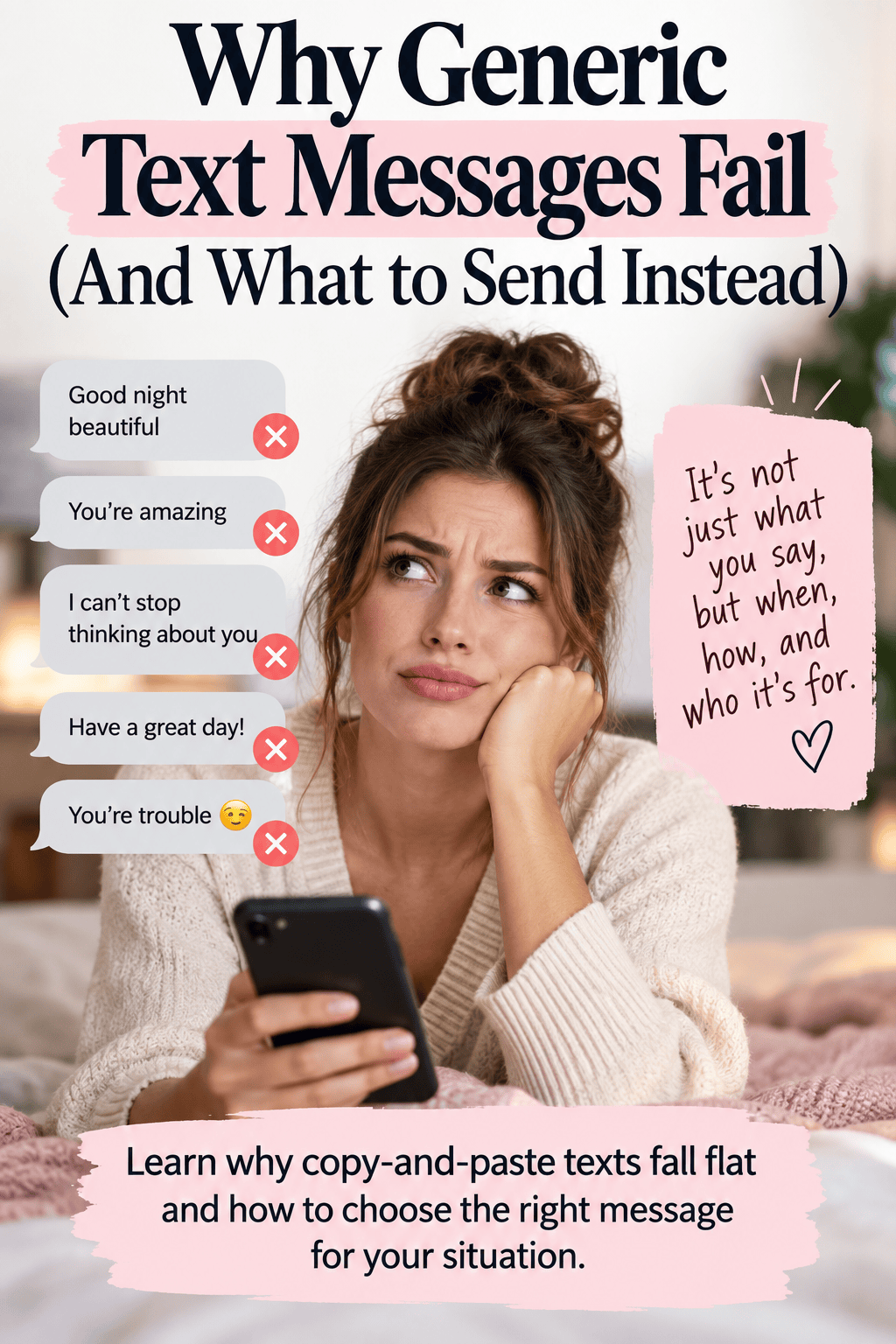
The problem with generic text messages isn’t that every example is bad. It’s that the same message can feel completely different depending on who sends it, when they send it, and what already exists between two people.
You’ve probably seen lists like this before:
“Send her THIS text, and she’ll think about you all night.”
“Text him these 7 words, and he’ll suddenly miss you.”
“The perfect good morning text.”
“The message guaranteed to get a reply.”
And sometimes the examples are actually pretty good.
That’s what makes this confusing.
You copy one.
You send it.
And…
Nothing.
Maybe you get:
“haha”
Maybe a heart reaction.
Maybe no response at all.
Meanwhile, the person who wrote the article made it sound as if those twelve carefully arranged words were about to change your entire dating life.
So what happened?
Usually, the problem isn’t that the text was objectively terrible.
The problem is much simpler:
The message was written for a situation that may have nothing to do with yours.
Generic text messages fail when we treat words like passwords.
Type the correct combination.
Unlock attraction.
But people don’t work that way.
The same message that feels irresistible from one person can feel awkward, confusing, or even annoying from someone else.
The words matter.
But the relationship around the words matters much more.
Imagine Receiving the Same Text From Two Different People
Suppose your phone lights up with:
“I can’t stop thinking about you.”
Now imagine it came from someone you’ve been dating for three months.
You’ve spent weekends together.
You’ve kissed.
You’ve talked until 2 AM.
You know there’s mutual attraction.
That message might feel wonderful.
Now imagine the same text arrives from someone you matched with yesterday and exchanged six messages with.
Same seven words.
Completely different feeling.
That’s the problem with treating texts like formulas.
Words don’t arrive alone.
They arrive carrying everything that happened before them.
How well you know each other.
How much attraction already exists.
Whether the other person has been reciprocating.
Whether the conversation was serious, playful, romantic, awkward, or barely alive.
The message isn’t the whole communication.
It’s simply the newest part of it.
1. Generic Texts Ignore Context
Here’s a common flirting suggestion:
“You’re trouble.”
That can be a great text.
Suppose she just teased you mercilessly about something on your date.
You send:
“I knew you were trouble.”
She understands exactly what you’re referencing.
There’s history around the words.
Now imagine you’ve exchanged:
“Hey.”
“Hi.”
“How’s your day?”
“Good.”
Then you suddenly send:
“You’re trouble.”
Trouble how?
What happened?
What are you talking about?
The problem isn’t the line.
The problem is that the line assumes a context that doesn’t exist.
And this happens constantly when people copy texting advice.
They copy the output without copying the circumstances that made the output work.
But you can’t copy circumstances.
You have to notice them.
2. A Good Text Usually Continues Something
Some of the best messages don’t start a new emotional direction.
They continue one that’s already developing.
Maybe she teased you.
You tease her back.
Maybe he shared something personal.
You acknowledge it.
Maybe you had a funny moment on your date.
You reference it two days later.
Maybe you’ve already been flirting.
You turn the flirtation up slightly.
Good texting often feels effortless because the next message grows naturally from the previous interaction.
Generic texts frequently do the opposite.
They interrupt the existing conversation with something that sounds like it came from a completely different person.
Imagine this conversation:
“How did your presentation go?”
“Pretty well actually. I was nervous but everyone seemed happy.”
“That’s great.”
Then suddenly:
“If I were there right now, you wouldn’t be thinking about work 😉”
Maybe that fits your relationship.
Maybe it doesn’t.
But if you’ve barely flirted before, you’ve just changed the emotional temperature from 20 degrees to 95.
No transition.
No indication they wanted to go there.
That’s not confidence.
That’s conversational whiplash.
3. The Same Text Can Mean Different Things at Different Stages
Consider:
“Good night, beautiful.”
In an established relationship?
Warm.
After a great third date?
Probably very natural.
After two messages on Tinder?
Maybe flattering.
Maybe generic.
Maybe too much.
Now consider:
“Wish you were here.”
From your boyfriend of six months?
Romantic.
From the person you met once for coffee?
Potentially intense.
That is why I like thinking about texting in stages rather than finding “the best text.”
The question isn’t:
“Is this a good message?”
The better question is:
“Is this a good message for us right now?”
That’s a completely different standard.
4. Generic Messages Often Sound Generic
There’s another problem.
People can sometimes feel when they’re receiving something you didn’t really write for them.
You’ve probably experienced it yourself.
Someone sends:
“Good morning beautiful. I hope your day is as amazing as your smile.”
Nothing objectively wrong with it.
But if the person has never spoken like that before, it can feel strangely disconnected.
Almost as if the message belongs on a motivational coffee mug.
Compare that with:
“Morning. Did you survive your 7 AM meeting?”
Not romantic.
Not poetic.
But if you know she was dreading that meeting?
It’s personal.
It says:
I listened.
That can matter far more than finding increasingly impressive adjectives.
5. People Want to Feel Seen, Not Processed
This may be the biggest problem with copy-and-paste dating advice.
The recipient shouldn’t feel like you’ve selected:
Option 7: FLIRTY TEXT – HIGH ATTRACTION
from a menu.
They want to feel like you’re talking to them.
Imagine someone remembers that you hate raisins.
Two weeks later they see a ridiculous raisin dessert and text:
“Found your worst nightmare.”
That’s not a legendary pickup line.
Nobody is selling a $97 course about it.
But it works because it belongs to the relationship.
No one else could send the same thing and get the same effect.
It has history.
And small pieces of shared history are incredibly useful in texting.
6. Inside Jokes Beat Internet Lines
Inside jokes are one of the easiest examples of this.
Let’s say you went bowling together.
She talked a huge game.
Then scored terribly.
Three days later, you walk past a bowling alley and text:
“Just passed a bowling alley. Thought about your legendary athletic performance.”
That message wouldn’t mean anything to somebody else.
To her?
Instant context.
She can laugh.
Defend herself.
Challenge you to a rematch.
Now you’ve restarted the conversation without asking:
“Hey, what’s up?”
again.
This is one reason shared experiences become increasingly valuable as dating progresses.
You slowly build a private vocabulary.
References.
Jokes.
Stories.
Things that belong to the two of you.
Generic texts can’t reproduce that.
7. The Problem Isn’t Using Examples
Let me clarify something.
I’m not saying you should never use texting examples.
I write articles full of them.
Examples are useful.
Sometimes you’re staring at your phone thinking:
“I genuinely have no idea how to phrase this.”
Seeing examples can unlock your own thinking.
The problem starts when you treat an example as a script instead of inspiration.
Suppose you see:
“Sleep well, troublemaker.”
You don’t need to copy it word for word.
Maybe the two of you joke about her being competitive.
You could write:
“Sleep well. Try not to spend all night planning how you’re going to beat me Friday.”
Now it’s yours.
The example gave you the structure.
Your relationship supplied the content.
That’s a much better way to use texting lists.
8. Generic Texts Ignore Reciprocity
This is where things become particularly important.
Suppose an article tells you:
“Send this flirty text tonight.”
Before you send anything, ask:
Has this person actually been flirting with me?
Are they:
- teasing you back?
- asking questions?
- initiating conversations?
- making plans?
- sending longer messages?
- finding reasons to keep talking?
- introducing flirtation themselves?
If yes, turning the flirtation up slightly may feel natural.
If you’re receiving:
“k”
“lol”
“maybe”
and twenty-four-hour response times…
the problem probably isn’t that you haven’t discovered a sufficiently powerful message.
Sometimes the conversation itself is giving you information.
And you need to be willing to listen.
9. Don’t Use Better Texts to Avoid an Uncomfortable Truth
This is one of the traps I see people fall into.
She’s becoming less responsive.
So he searches:
“text to make her interested again.”
He’s stopped initiating.
So she searches:
“text to make him chase me.”
Sometimes the right message helps.
Misunderstandings happen.
People get busy.
Conversations lose momentum.
But texting advice becomes dangerous when we use it to avoid considering:
Maybe their behavior is telling me something I don’t want to hear.
You should never need increasingly elaborate psychological techniques to keep someone communicating with you.
Attraction needs participation from both sides.
10. Timing Changes the Meaning of a Message
Imagine sending:
“I miss you.”
Ten minutes after saying goodbye.
That might be adorable in an established relationship.
After your first twenty-minute coffee date?
Possibly a little much.
Now imagine the same message after you’ve been apart for two weeks.
Completely different.
Time changes meaning.
So does what just happened.
A playful text after a great date can extend the emotional momentum.
The same text after an argument may seem dismissive.
A romantic message after someone opened up emotionally can feel intimate.
The same message while they’re trying to discuss a serious problem can feel evasive.
No text escapes context.
11. Tone Matters More Than People Think
Written communication removes a lot of information.
No facial expression.
No voice.
No little smile showing you’re joking.
That’s why:
“You’re ridiculous.”
can mean:
“I’m playfully teasing you.”
or:
“I genuinely think you’re an idiot.”
The relationship usually supplies the missing tone.
If you already tease each other, they probably understand.
If you don’t?
The text has to do more work.
That’s also why emojis can occasionally help communicate tone.
Not seventeen of them.
Just enough to clarify something playful when necessary.
12. Don’t Try to Sound Like Somebody Else
This one matters.
Suppose you’re naturally straightforward.
You find a texting expert telling you to send:
“There is something indescribably magnetic about your energy tonight.”
You send it.
She responds:
“What?”
Because three minutes ago you wrote:
“lol that dog is massive”
and suddenly you’ve transformed into a Victorian poet.
Good texting should still sound like you.
Maybe a slightly more confident version of you.
Maybe a more playful version.
But still recognizably you.
Otherwise, even if the message works, you’ve created another problem:
Now you have to keep pretending to be the person who wrote it.
13. The Goal Isn’t to Keep Them Texting Forever
Texting advice has a strange irony.
People spend hours learning how to keep conversations going.
But if you’re dating someone you actually want to see, the ultimate objective shouldn’t be:
Infinite texting.
At some point:
“I’m enjoying this. Drinks Thursday?”
beats another four days of entertaining conversation.
Texting can:
create anticipation.
maintain connection.
show interest.
build playfulness.
help arrange dates.
But eventually, you need real interaction.
A relationship cannot live forever in a notification bar.
What Should You Send Instead?
Let’s make this practical.
Before sending a message, ask yourself four questions.
1. What just happened between us?
Did you have a date?
A funny conversation?
A serious discussion?
Did they tell you about something important?
Start there.
2. What level of connection already exists?
Strangers?
New matches?
Two dates?
Dating regularly?
Relationship?
Your message should match that level.
3. What are they giving me back?
Are they participating?
Flirting?
Initiating?
Showing enthusiasm?
Match the reality rather than the outcome you wish existed.
4. What do I want this message to do?
Make them laugh?
Show appreciation?
Flirt?
Arrange a date?
End the conversation warmly?
Don’t ask one text to accomplish twelve things.
A Simple Example
Suppose you’re talking to someone who mentioned they have an important interview tomorrow.
The generic approach might be:
“Good morning gorgeous. I hope your day is as amazing as you are.”
Fine.
But you could instead send:
“Good luck today. You’ve got this.”
Or later:
“So… did they realize they desperately need to hire you?”
Now you’re communicating:
I remembered.
That’s personal.
And personal is often what generic texting advice is missing.
The Best Text Usually Comes From Paying Attention
This is the bigger principle behind almost every texting article I’ve written.
You don’t need to become a wordsmith.
You need to become more observant.
Notice what makes them laugh.
Notice what they talk about passionately.
Notice what they remember about you.
Notice whether they’re moving toward you or away from you.
Notice the little shared experiences that nobody else has.
Then your messages become easier because you’re no longer trying to invent attraction from nothing.
You’re responding to something real.
So Are Copy-and-Paste Texts Useless?
No.
They’re tools.
Use them like templates.
Take the structure.
Understand why it works.
Then adapt it.
For example:
Generic:
“You’re distracting me.”
Personalized:
“I’m blaming you for the fact that I’ve accomplished absolutely nothing since you sent me that ridiculous video.”
Generic:
“I can’t wait to see you.”
Personalized:
“I’ve been thinking about Friday. You’re still not winning at mini golf.”
Generic:
“Good night beautiful.”
Personalized:
“Sleep well. And don’t spend all night rehearsing your terrible argument about pineapple pizza.”
The basic emotional purpose hasn’t changed.
The message belongs to your conversation now.
The Words Aren’t the Magic Part
That’s ultimately what I want you to remember.
There are good texts.
Bad texts.
Funny texts.
Flirty texts.
Romantic texts.
But no collection of words automatically creates attraction.
The real skill is knowing:
what fits the person,
what fits the moment,
what fits the relationship,
and what the other person is giving you back.
Once you understand those things, examples become useful.
Without them, even a brilliant line can fall completely flat.
Want Examples for the Situation You’re Actually In?
That’s why I’ve organized many of my texting guides around specific moments rather than promising one universal message.
If you’re trying to flirt, you need something different from the person saying good night.
If you’ve just had a first date, that’s different from texting your boyfriend or girlfriend.
And if someone keeps texting but never wants to meet, another clever line may not be the solution.
Choose the situation that actually matches where you are, then choose the message.
That’s a far better strategy than trying to force your relationship to fit somebody else’s script.
If You’re Texting a Woman
The right message depends on what you’re actually trying to do.
Want to make the conversation more flirty? Need something to send before bed? Or are you trying to create more attraction without sounding forced?
Start with the situation that matches where you are:
→ 15 Things to Say to Turn Her On Over Text
→ Good Night Messages for Her: 35 Texts She’ll Actually Want to Receive
Don’t look for the most powerful text.
Look for the message that fits the moment you’re already in.
If You’re Texting a Man
The same principle applies when you’re texting a man.
A sweet message, a flirty message, and a romantic message can all work — but not necessarily at the same stage of the relationship.
Choose what you’re actually trying to communicate:
→ Good Night Messages for Him: 35 Texts He’ll Actually Want to Receive
→ Sweet Text Messages That Will Make Him Think of You All Day
→ April’s Article About What to Text a Man Without Pushing Him Away
The goal isn’t to find words that magically control how he feels.
It’s to send something that fits the connection you are already building.
Rickard

What do you think about the article you've just read? Please tell me below.